
 EN
EN
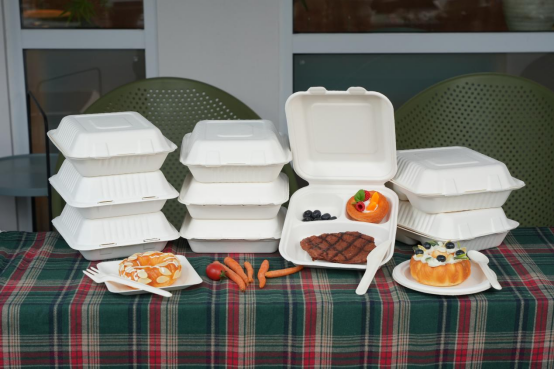
Functional Durability of Bagasse Burger Boxes Under Real-World Fast-Food Conditions
Leak and grease resistance with hot, high-fat burgers
Bagasse burger boxes really stand out when it comes to keeping oily foods contained. These boxes handle greasy stuff like cheeseburgers and fried chicken sandwiches without breaking down. What makes them work so well? The material is packed full of lignin fibers that form a pretty solid barrier against grease. Tests show these boxes only let grease penetrate about 0.15 to 0.32 millimeters deep, which beats regular paperboard hands down. This means no soggy messes happening while the food travels those crucial 15 minutes from the kitchen counter to the customer's table. Restaurant tests have proven that even when these boxes come into contact with hot 85 degree Celsius patties smothered in melted cheese and sauce, they stay firm and don't turn into a wet disaster. No more dealing with that annoying soggy box problem that drives everyone crazy with traditional packaging options.
Heat retention and structural integrity during 30-minute hold times at 70°C
Under simulated fast-food warming conditions (70°C for 30 minutes), bagasse burger boxes retain both food temperature and mechanical strength. Testing shows:
- Surface temperature remains within 5°C of initial serving temp
- No warping or lid separation occurs, even with internal steam buildup
- Compression strength holds above 84% after repeated thermal cycling
This resilience stems from bagasse’s natural thermal stability—withstanding temperatures up to 95°C without chemical leaching, unlike plastic-lined alternatives. Its controlled breathability also minimizes condensation accumulation, a key cause of paperboard weakening during extended hold periods.
Load-Bearing and Logistics Performance for High-Volume Operations
When it comes to big scale warehousing, how well items stack together really affects how much gets moved through the facility and how efficient workers need to be. These reinforced bagasse burger boxes have special ribs built into them plus those clever corner designs that lock everything in place. They can actually hold up when there's pressure applied at around 32 kilograms per square meter according to some recent tests from Eurofins in their 2023 packaging study. We also ran our own tests where we left stacks sitting for 48 straight hours in damp conditions. What we found was pretty impressive considering how tricky moisture can be for most packaging materials.
| Performance Metric | Standard Packaging | Reinforced Bagasse Burger Box |
|---|---|---|
| Compression Failure | 18 kg | 28 kg |
| Sidewall Deflection | 9% | 3% |
| Recovery Rate | 72% | 94% |
Operational benefits include moisture-resistant fiber bonding (retaining rigidity at 85% relative humidity), minimal lateral slippage due to interlocking geometry, and tight dimensional tolerances (±0.3 mm) that support seamless integration with automated palletizing systems.
Testing how well lid seals hold up during actual delivery conditions has become increasingly important. Recent third party tests simulated what happens during those final delivery miles. They included things like 30 minutes of vibration at 15Hz frequency, lots of back and forth tilting at about 45 degrees, plus sudden temperature changes going from cold fridge temps around 4 degrees Celsius all the way up to scorching 65 degrees. What they found was pretty impressive. Modified pulp fiber lids with special heat activated biopolymer seals showed much better performance. These new lids kept 98% of the grease contained compared to just 79% with regular PLA lined containers according to research from Materials Innovation Lab in 2024. The secret seems to be in how the biopolymer works. It moves along with the bagasse material as temperatures change, which stops the seal from wearing out over time. Plus these seals still meet FDA standards for fat migration even when exposed to extreme temperatures for three whole hours straight.
Commercial Validation: Bagasse Burger Box Adoption in Global Fast-Food Chains
Southeast Asian chain case study: Reinforced bagasse burger box implementation and failure rate reduction
One of the big fried chicken chains operating throughout Southeast Asia recently switched to these reinforced bagasse burger boxes because several regions there have banned polystyrene products. The plant based containers held up pretty well even in those sweltering kitchen environments where temperatures can hit around 35 degrees Celsius and humidity stays at about 70%. They kept their shape and resisted oil seepage throughout busy service periods when orders pile up fast. When the company upgraded to dual walled box designs, customer complaints about damaged packaging during deliveries dropped by roughly 25%, and nobody had to deal with those annoying squashed burgers anymore. Restaurant workers noticed something else too during rush hour chaos - the boxes stacked better than before. Turns out this has something to do with how much grip the material provides on surfaces, though most folks just call it "less slippery".
McDonald's Japan: Performance Benchmarking and Operational Scalability Insights
McDonald's Japan ran tests at over 300 spots throughout Tokyo to see how well these new boxes would work. They checked things like how fast food moves through the system, how hot the burgers stay, and whether they hold up during deliveries. The plant-based burger boxes kept heat just as good as regular plastic ones after sitting for 45 minutes at around body temperature without letting grease seep out. When restaurants actually used them last year, almost all lids stayed sealed even when delivered on scooters zipping through crowded city streets. That matters a lot in places where traffic is tight and deliveries need to happen quickly. As production scaled up past half a million boxes each month, the extra costs dropped by nearly two thirds. Customers in areas focused on green living gave higher marks too, with satisfaction jumping 14 points overall. All this shows that switching to these eco-friendly boxes isn't just possible technically, but makes real business sense for fast food chains worldwide looking to cut waste.